Wednesday, September 10, 2014

Another Thought


What I found interesting in this week's readings of the wrestlers in Top 100 Pro Wrestlers of All Time we can see a pattern beginning for the strangle hold (pun intended) that McMahon began on the industry. This can be exemplified with my previous post of Andre and McMahon using Andre exclusively, not allowing him to fight for other promoters (except for Japan).

Then in the Dusty Rhodes section, during the promotional wars between Jim Crockett (mid-Atlantic territory) and McMahon Jr. (Northeast territory). It was Rhodes who was the main figure with Crockett, including the use of Starrcade, a TV production by Crockett. When Crockett’s business started to suffer, McMahon went behind the scenes to strong-arm the cable industry to not carry Starrcade, otherwise McMahon would not allow them to carry any WWF shows, which by now had tremendous success with WrestleMania. So, McMahon basically forced Crockett and Rhodes out. Ironically, Crockett sold out to Turner.

In another section, Jack Brisco, it is mentioned that Jack and his brother, Jerry, changed wrestling history in 1984 when they sold Georgia Championship Wrestling to McMahon. So what I am seeing here is McMahon using leverage to force people out, while both growing and consolidating his power base.

Wrestling: A Game of Charm

For many decades now, wrestling has been a spectacle of both athleticism and theater. It takes two completely different forms of entertainment and melds them into something so uniquely compelling in its own right. Not only must a successful performer be physically capable, but they must also be charismatic and able to captivate an audience. However, in some cases, one may make up for in good storylines and charisma what they lack in mind-blowing skill. An example of this seems to be Dusty Rhodes. While he didn’t quite have the ability to woo an audience with a technical and beautifully executed set of moves, he could work a crowd and a mic like nobody’s business. His feuds with top heels kept him relevant and interesting. It is how he is best remembered.
Dusty Rhodes
            I feel like we can see many examples of this in today’s wrestling. We have so many teams that, as a group, are so intriguing and fun to watch. As a collective unit, their personas and narratives are alluring and entertaining. However, when separate units, they’re true skill bubbles to the surface for all to see and it can sometimes be disappointing. I believe Roman Reigns is a good example of this. When The Shield was a unit, each team member brought something unique and exciting to the table. They were so fun to watch, the matches were mesmerizing. However, when they broke up and they each got an individual push, they could no longer fall back on the safety of a group. Roman Reigns was the powerhouse of The Shield.
Roman Reigns
During tag team matches, he was always saved for last. The anticipation that built up throughout the match was almost unbearable. And when they would finally tag him in, the crowd would lose it as he speared or Superman-punched his foe. But once they were no longer one unit, Reigns could no longer hide behind his brothers. He was front and center stage with his set of four moves.

Now that might have been the end of Reigns if it wasn’t for one thing – people still freaking love him. Everything from his entrance to his intimidating presence to his growling speeches. He has a presence that sells, and it sells well. Like Dusty Rhodes, he may have a limited skill set in terms of moves, but he has the demeanor to make it work. And I think that’s part of why wrestling is so interesting; you may be an average Joe physically, but if you’ve got the chops to sell yourself and to entice an audience, then you may stand a chance.

Interview with wrestling manager, Jason Saint


Katie Clark: To start, what is it exactly that you do right now [within the business]?

Jason Saint: Essentially, my current title is that I'm a ringside manager. I perform with a team known as #Spotlight, which I manage, that's comprised of several superstars and allies over several companies.
Manager Jason Saint (front) and the rest of #Spotlight

KC: So do you work for a Louisville based company?

JS: The companies I work for are based out of Louisville, mostly, but have shows in Indiana and Illinois.

KC: What are the companies that are up there?

JS: IWA Mid-South, Evolution Pro Wrestling, and Furious Wrestling Society.

KC:  So what other roles have you played in the company? Have you always been a manager?

JS: I've been a manager since October 26th, 2013. Prior to that, I worked in several different departments in other companies.

KC: Out of your past roles, what has been your favorite thing to do and why?

JS: When you say past roles, you mean within the last month and beyond or from the stuff I did at OVW? Do you mean in the ring or behind the scenes?

KC: Well, let me back up. First, what kind of stuff did you do at OVW? Second, out of everything you've ever done within the realm of wrestling, what has been your favorite memory IN the ring and what has been your favorite memory OUTSIDE the ring (behind the scenes)?

JS: At OVW, I did everything under the sun BUT wrestle. I helped build the ring, transport it, did the merch table, designed merch, took photos, worked the camera, learned from guys like Al Snow, Paredyse, etc. about wrestling and just generally soaked up knowledge and helped the rookie class learn as much as they could before they became part of "the boys."

In the ring, my favorite thing that I've done is when Tripp Cassidy faced Christian Skyfire in a Toy Box Death Match. It was insanely ridiculous, and I spent most of the match just jaw jacking with fans, putting Tripp over (a term used for 'making my guy look good'), and stealing the toys that kids would say they wanted. I opened a ninja kit, one of those cheap $2 ones that had like a star and a belt, etc., and I threw a ninja star at Christian. He just kind of stared at me so I took off running and the crowd cracked up.

Backstage, my favorite thing about being there is evolving my character and getting tips and pointers from legends. Guys like Tommy Dreamer, Sabu, and most notably, Kevin Sullivan, who actually pulled me aside to give me some amazing compliments on my work. That was huge for me. That brought tears to my eyes...after he walked away, of course.

KC: How much different was it to work for a developmental promotion such as OVW compared to some of the lesser known indie companies?

JS:  The biggest difference is that it's MUCH more relaxed on the indies. Guys in OVW were so stressed out and working so hard to be better than each other in every aspect so that they could get signed right away, rather than to be the best version of themselves so that when they DO get signed, they've got tons of experience. That's what the indies is all about, is being as much of a standout as you can be and learning, learning, learning. In OVW, for years, you weren't allowed to wrestle on any shows BUT OVW shows. In OVW, the guys were all very talented, but they all came from the same class and wrestled the same style. Several of them wouldn't sway from that style. You essentially saw the same match over and over with different kicks, thrusts, or finishers, with very few exceptions (from wrestlers like Paredyse, Jamin Olivencia, the Blossom Twins, Mike Mondo, etc.). In the indies, these guys come from Michigan, Tennessee, St. Louis, Chicago, Dayton, Cincy, etc. and they're all so different from each other. That's the best part, to me, is the variation of styles.

KC: Well, tell me a little bit about the team you manage now.

JS: The team I manage is #Spotlight. The group is led by me, Jason Saint, a film director who started out using wrestling as a means to expand his resume. After a lot of early success, things started to dwindle, causing me to lose my shit a little bit and I started recasting the group. Rather than a Hollywood-bound group of hopeful stars, the group has metamorphosed into a walking horror show. The group went from flash and flair to grit and hits.

The team is currently composed of "The Real Deal" Derek Neal, who has defeated Mitch Page in more consecutive matches than anyone in history. Tripp Cassidy, aka "The Blue-Eyed Devil", who is the current EPW Openweight Champion. He's a handsome young kid, but an absolute lunatic. Chase Matthews, known as "The Mass Murder Suspect", who has gained several victories and has defeated 10 other wrestlers in scramble matches at the same time. Josh Crow, who's tall, athletic, and fears absolutely nothing. That's the core group, as seen in my default photo. We also have "Good Looks" Donnie Brooks, who is part of the New England chapter, Zodiak, who occasionally teams with us when we need backup, and Ludark Shaitan of Mexico, who throws up the hashtag when she's about to make headlines.

I've managed over 20 wrestlers altogether, though.

KC: Well, to kind of talk about the wrestling biz as a whole, how much do you think wrestling has changed since you started becoming involved with the business? Do you think it's changing for the better?

JS: I really haven't been involved long enough to notice any significant changes, outside of the match quality increasing, which is always good. The guys I work with are all getting better, as I offer tips every other turn.

KC: Last question. Looking at the WWE, we're starting to see some shifts into a new era. I mean, we've reached a point where the characters are no longer seen solely within the ring, but social media has made superstars so accessible now. How do you think social media has impacted the business? Both mainstream and independent.

JS: Negatively, and positively. What social media has done is take away the allure of a superstar. In the 1990's, you had NO IDEA that guys had personalities outside of the ring. You assumed a guy like Roman Reigns would just be in the gym or training in a studio somewhere all day. Now, you're like, "oh, he ate at a nice restaurant and was dissatisfied with the service". I'm 28 years old, and there's still a part of me that wants to believe I won't see Reigns at a Harbor House. There's still a little kid in every wrestling fan that doesn't want to see The Undertaker using a touch screen phone.
However, at the same time, people are able to understand the struggles and legitimate worries of some pro wrestlers. Guys like Zack Ryder, who bless his heart, was primed and ready to be a top tier talent only to have it dropped over nothing. It's depressing, almost, but you believe in these guys and want to see them succeed that much more.

Also, about the internet... I hate rumor sites because they completely destroy what the business was made for. The rouse, the unpredictability, the excitement, the "What's gonna happen next?" the surprises, the joy, the hope, it's all gone because some jerkoff said "in 2 months, the WWE wants to push The Big Show for some reason". I liked wrestling a lot more when I had no idea what was about to happen in any way, shape, or form.


You can find out more about Jason Saint and #Spotlight here.

Average Joes, Average Sonnys

I always enjoy reading from Top 100 Pro Wrestlers of All Time because most of the time, the wrestlers are those of whom I’ve never heard (This should not be surprising, considering the fact that I started watching wrestling less than a year ago, and am only well-acquainted with current WWE RAW wrestlers).  As I started reading the passages selected for today, I came to Bruno Sammartino (Number 15 in the Top 100).  I love the way that Molinaro so nonchalantly states that Sammartino “defeated Buddy Rogers for the WWWF World title at Madison Square Garden in 48 seconds.”  Now, that’s a match I’d like to see!


I also liked reading about Andre the Giant, though every match of his I watch makes me sad.  I can’t help but see the disease that simultaneously gave him the ability to be great and led to his ultimate demise.  This is especially true of his later matches, and chapter five of Dave Meltzers Tributes II makes the decline of Andre’s body painfully obvious.  Despite the difficulties, there is still joy in Andre’s life.  I enjoyed hearing the stories retold in Meltzer’s book (pg. 74), and I appreciate the honesty on the part of Meltzer in acknowledging the tall tale tendency in the professional wrestling world.  There’s proof of that in the many versions of the story that emerged to explain how Andre was introduced to wrestling in the U.S.

Early Andre the Giant
Andre the Giant, WrestleMania 3 


Mark Workman’s “The Differential Perception of Popular Dramatic Events,” drew some criticisms from me at first, until I realized it was written in the 70s.  In his article, Workman interviews two wrestlers and three fans about their wrestling views; the fan segments caught my attention (I realize that the interview was not the main discussion of the article, but it was the most interesting point, perhaps unintentionally, in my opinion).  The first, Joe “has swallowed the official rhetoric without a modicum of skepticism,” according to Workman.  He believes completely wrestling is real; it’s “’brute force against brute force.’”  He takes wrestlers’ personas at face value, and believes that the portrayed hurt is real.  The second “representative fan” is Mike.  He thinks that some matches are fakes, while others are real.  When a guy goes down after a solid punch, it’s real, whereas any imbalance of action and reaction constitutes a fake match.  The third fan, Sonny, has the most modern view: he knows it is unreal, “but finds wrestling to be entertaining nevertheless.”  These three views were supposedly representative of the majority of other wrestling fans, which was what irked me the most.  The first two views took up at least a full page, while Sonny’s view only took up a tiny 2.5-sentenced paragraph.  I was upset with the portrayed gullibility of the wrestling fan community… until I realized this was written in 1978— years before Vince McMahon would reveal to the world that “wrestling is all phony” (as worded by Ole Anderson in his book, Inside Out).  This realization changed my view on these fans’ notions of wrestling as real vs. wrestling as fake.  It is interesting to see how a little change like that completely morphed the view of professional wrestling, so that there are virtually no "Joes" or "Mikes" around today. 

Larger Than Life


I would like to focus on one of my personal favorite wrestlers, Andre the Giant. I saw him wrestle twice on TV in the 1970s, and followed his career; I took an instant liking to him for some unknown reason. Maybe it was due to the fact that he was billed as being seven feet, four inches tall, and weighing over 385 pounds. It was not until the end of his career that he weighed in over 500 pounds, and this was due to poor health and being out of condition. He was born with a rare disease, acromegaly, which was the cause of his giantism. Ironically, his disease brought him international fame and fortune, and was responsible for his early demise. According to Tributes II, he knew his days were numbered early in his life. As he could no longer grow in height, his hands, feet and head became somewhat distorted, and he began to age very fast.

Interestingly, Andre started wrestling in Europe a full six years before anyone from North America found him. He then performed in Canada and became a star, setting indoor wrestling attendance records. His angle was that he was the nicest guy in the world until you make him mad, then there was no stopping him against anyone (p. 70).

Andre worked under Vince McMahon Sr. here in the U.S., and McMahon did not allow Andre to work for any other promoter, except for his Japan tours. McMahon also kept Andre away from the top heels, “so as not to damage the territory for the long term” (p. 72).  In the later years, fans demanded he be set against the top heels of the time.

How big of a draw was Andre? In 1974, he was listed as the highest paid wrestler in The Guiness Book of World Records with a salary of $400,000, and close to $500,000 when wrestling in the Northeastern. His second match with Hulk Hogan drew a TV audience of 33 million. He appeared on TV shows and commercials. Other wrestlers loved him as Andre would never hurt them, even with his enormous hands.

He became an iconic figure in wrestling, and along with this there were iconic tales of his drinking and eating habits, such as drinking 119 beers at a time in a hotel lobby, then passing out. Since no one could move him, the hotel staff put a piano cover over him while he slept it off. There are also stories of him going into a restaurant and ordering everything on the menu. Andre knew how to live larger than life, and that his time would be cut short.

So why did I and hundreds of thousands of other fans love to watch him? Our reading suggest that we initially watched him as a novelty, but we then understood that he was the real deal. How could a man that big do a dropkick? I think it goes deeper than that, going back to some of the origins of U.S. wrestling itself, to that of the circus, and, P.T. Barnum, and where people went to see giants, went to see one-of-a-kind people doing what they do best, and they went to see wrestling. This
 side show became the main attraction in a very big way.

Tuesday, September 9, 2014

9/10/2014 Post for History of Pro Wrestling

A quote that I really thought helped give insight into the purpose of Pro Wrestling came from "The Art of Professional Wrestling: Folk Expression in Mass Culture" by John A. Gutowski. The quote reads "...transformed a basically dull sport to a crowd pleasing spectacle." I think this is a perfect way to explain how and why Pro Wrestling got started in a short phrase. Amateur wrestling is very boring. There's not a huge fan base for it because not many people find it entertaining enough to watch. However, Pro Wrestling is found far more entertaining and, therefore, has a far bigger fan base. This is basically because Pro Wrestling seems far more violent, key word is "seems." While amateur wrestling is real, it doesn't allow a view to get out his/her frustration out by watching it.  

One thing that I found very interesting in "Andre the Giant" by Dave Meltzer was that people considered him to be 7'4, but he wasn't. People were so interested in him because the local magazines made it seem like he was the most "giant" person in the world. They exaggerated his height and weight to create more news about him. However, there were other athletes, that the article mentions, that were even taller than him. However, since he started out in France and there wasn't international news, his name of being "Andre the Giant" spread fast. I wonder if he would have been as famous if he was born in today's world-wide connected society. I don't feel like he would have been.

Our Class in the Bowling Green Daily News

In case you all haven't seen it yet, our class was featured in today's issue of the Bowling Green Daily News.

WKU course is a cerebral look at pro wrestling culture


WKU course is a cerebral look at pro wrestling culture
Photo by Austin Anthony

By CHUCK MASON The Daily Newscmason@bgdailynews.com 783-3262

It’s a body slam to the senses – a cerebral look at a cultural phenomenon that’s survived in America since before World War II and that has had more storylines than “Days of Our Lives” and “All My Children” combined.
“Sex, Lies and Headlocks” isn’t required reading for your average college course at most universities.

Then again, not every college course has been the subject of a question on “Jeopardy” under the category “Pop Culture College Courses” or made BuzzFeed’s “23 Awesomely Weird College Classes To Enroll In Immediately,” where “Topics in Comparative Media: American Pro Wrestling” was listed No. 13 in 2013...

Monday, September 8, 2014

Wrestling and Morality

The introduction of Steel Chair to the Head was not only an extremely insightful (if not slightly florid/obfuscated) defense of wrestling, but also a solid condemnation of "reformist rhetoric" (so called in the text) and the idea of censorship. Moving from a discussion of the artistic merits of professional wrestling, Nicholas Sammond addresses the absurdity of conventional wisdom regarding the moral degradation of American society (that is, that our habit of consuming theoretically improper popular entertainments from "unscrupulous marketers" is the cause of our societal ills). Calling out those who speak against the social shortcomings of wrestling (misogyny, racism, violence, etc.), Sammond turns the table and decries the ineffectiveness of regulation and censorship as opposed to intelligent debate and dissent. According to Sammond, in the face of much blustering and impassioned speeches from both political parties, the average citizen turns to apathy or political incorrectness out of boredom. I found this especially poignant because as a relatively young person, I can identify with a sense of disenfranchisement and disconnectedness that comes from being informed of what is moral and immoral, and the tendency to lapse into either not caring or embracing immorality for the sake of rebellion.
Citing past offenses of reformist rhetoric, Sammond talks of public indignation to rock-n-roll music as being anxiety over the integration of African Americans into mainstream American society and the political machine moving from various disenfranchised groups throughout history (women, immigrants, African Americans), painting them as intellectually inferior to white males and in need of guidance and protection from corruptive influences. Today this group in need of moralizing is youth, and Sammond writes that attempting to regulate or withhold images ignores the larger need for public action against the various economic and cultural iniquities that exist today, and are portrayed in pro wrestling. On page 17 Sammond writes that "...apathy and political incorrectness are the symptoms of the improper stewardship of an infantilized majority." The youth of today are apathetic or intentionally immoral due to the protection of the censors, because the persons that claim to be looking out for the best interest of youth are not looking to educate, but to collar and oppress. The real issues, Sammond writes, are less what a child watches on television and more their economic and social status. To take that a bit further into cynical college student territory, the upper class points at morally-questionable lower class entertainment as promoting poor values, while denying these lower classes the opportunity to truly educate themselves and adopt their own value systems through informed debate, preferring to withhold knowledge and censor violence to leveling the playing field and losing their position of power.
So in defending wrestling against it's detractors, Sammond constructs an argument in which he not only eloquently defends the sport ("sport"), but also takes a jab at these detractors, politicians and activists who are really more interested in keeping the status quo tipped in their favor rather than keeping young children from learning a penchant for violence or misogyny from watching Smackdown.
Sammond goes on to talk about how wrestling parodies social injustice and acts as more of a moral mirror for contemporary society, insinuating it's usefulness as a tool for introspection and presumably social change. I take some issue with this based upon some other comments he made in discussing when the WWE went public, and how it was portrayed. Sammond likens wrestling to a celebration of the triumph of the individual over oppressive social systems, and how buying stock in WWE was an opportunity for the "little guy" to escape the bonds of his job and become independently wealthy through stock ownership. He concludes that both of these point to larger "sociocultural formations that oppose an active and productive masculinity to a passive and consuming femininity, which positions collective social action as emasculating" (13).
My issue then is that wrestling seems to be a type of vicarious catharsis for the spectator, an opportunity to project one's anger at his or her situation onto a wrestler who will ultimately prevail over the heel. This seems like it would only continue to beget a "passive and consuming" attitude, which rather than inciting the larger populace to go out and really work to change the pervasive misogyny, racism, and violence in this country, wrestling would act as just another opiate of the masses, giving viewers the escapist opportunity to sit back and watch their favorite wrestler fight their battles for them. So in summation, I am thoroughly convinced wrestling is not a corruptive influence on the American people, though I question the effectiveness of wrestling as a tool for social change, be it through parody or otherwise.

Sport to Sports Entertainment

Lou Thez
http://www.onlineworldofwrestling.com/
20313/time-machine-the-early-years/
The basic idea that I came away with from reading the first few chapters of Steel Chair to the Head and Ole Anderson’s Inside Out was the drastic change that has taken place in the industry of professional wrestling.  Ole Anderson, recalling wrestling in the ‘60s and ‘70s, would never tell anyone that the business was fake.  Vince McMahon, on the other hand, blatantly told the fans that “wrestling is all phony,” which really “ticked off” Ole Anderson at first
(Inside Out, 85).  What caused the shift in wrestling from mostly shoots (according to Anderson) to McMahon’s “sports entertainment”— requiring in-depth plot and action scripting— that we know and love today?  Laurence de Garis (mentioned in Steel Chair to the Head, 12) thinks that the “mainstreaming” of wrestling “signals the decline of the form as craft and the disempowerment of wrestlers as workers,” though I doubt that a single phenomenon can aptly point to the change.  Now, wrestlers are “commodities,” according to Sammond.  They have their own products that they are trying to sell (literally or figuratively): action figures, t-shirts, personal/sexual appeal, storylines.... For the most part, they are as expendable as the action figures they resemble.


WWE RAW
http://www.allwrestlingnews.com/wwe-extras/
wwe-raw-highlights-ajs-pipebomb-gauntlet-match/
I really like how this phenomenon is explained in the passage on page 24 of Steel Chair to the Head: in a wrestling match, the audience couldn’t care less about “the rise and fall of fortunes”—who is winning or losing the match in that moment—but instead expect “the transient image of certain passions”—anger, jealousy, lust, greed….  The wrestling fan is not really interested in the outcome of a match, but in the sum of the passions that led to that moment.  This is shocking at first, and I imagine that many would argue against the statement—that they really do care that Brock Lesnar beat John Cena at Summerslam, for example—but those two competitors could be replaced with any other face and heel combo, built into a similar rivalry, and still draw the same fan reaction.  It’s not based on who’s fighting or who wins.  It’s about the emotion, the drama—the passion.


...and apparently about acrobatics...
WWE Divas' Match?  No, just some acrobatic friends.

The Joanie Laurer That Never Was

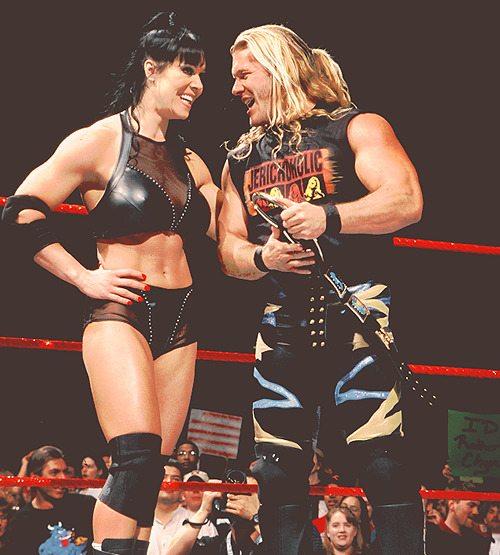
Chyna entered the WWF (now WWE) in 1997 as the "Ninth Wonder of the World." She barged in with the lean and intimidating physique of a bodybuilder. The WWE, being the savvy and intuitive business that they are, could tell that something was still missing...

Ah, yes! Tits and ass.

And they weren't wrong. 
Chyna & Chris Jericho

A few surgeries later and Chyna was everything that they hoped she would be. A sex symbol that could kick some serious ass. (Because why just destroy your opponents when you can look hot doing it too?) Regardless of how you looked at it though, she was wildly popular and brought in some serious money. People seemed to like her. According to Steel Chair to the Head, "she offered a delightful counterpoint to the powder-puff 'managers'" that would accompany their men to the ring. However, she still seemed to symbolize an "immature hetero-masculine desire," while sometimes enacting "a slavish subjection to her male love-interests." In other words, they couldn't let her just be badass for the sake of being a badass. They had to sell her.

And I think that that's what makes then-wrestling so different from now-wrestling. At one point in time, wrestlers had the power to create their character and control their performance. While the "bigger picture" seemed to be planned, the details were left up to the wrestlers. If you wanted to make it in the business, you had to be both athletically capable and creatively inclined (to an extent.) In other words, you had to be able to sell yourself. Now, the company sells you for you. Writers are in charge of creating you and selling you to the public. (The WWE has essentially become one of the most successful pimps in the world.) 


"The work of wrestling--the refinement of moves, the development of animosities and alliances, the creation of characters--happened in motel rooms and locker rooms, not in front offices. New wrestlers learned from old-timers, and often skills were handed down from generation to generation within families. Now...wrestlers are less and less skilled workers and more products, commodities who play workers on television." -Steel Chair to the Head (p. 12)

9/7/2014 Post for History of Pro Wrestling

As I was reading the book, "Inside Out," by Ole Anderson with Scott Teal, I found a particular story interesting. In Chapter 3, the author gives an account on how he got into Pro Wrestling. It was so intriguing because he got asked by someone at the gym to give Pro Wrestling a chance. As he began to get into it, he believed that Pro Wrestling was still real because their "practice," or I see it as initiation, was so intense and painful. During this time, they had actual wrestling or shoots. This is so interesting to me because he got involved with Pro Wrestling without knowing really anything about Pro Wrestling. He didn't even genuinely realize that Pro Wrestling was fake. I can relate to that because I am taking this class without really knowing anything about Pro Wrestling. One question that I really wanted answered, starting off the class, was if Pro Wrestling was real or fake. Within the first class session, I quickly realized that it was definitely fake.

Another detail about the book, it is always written in wrestling lingo. It's like wrestlers have their own vocabulary that becomes habit or instinct to use. Throughout the book, words like "business," "work," "worker," etc. are used. This is extraordinary to me because the average person, I just mean a person who isn't really a fan of wrestling, would never think of these words as being used within Pro Wrestling. However, it does make sense once I begin thinking about it. They are working and Pro Wrestling is a business.

Sunday, September 7, 2014

Good vs. Evil vs. Justice

In Steel Chair to the Head, Barthes contends that professional wrestling represents a mythological battle of legendary themes between good and evil (p 30). Barthes refers to the “perfect bastard,” who is asocial, unpredictable and only abides or accepts the rules when they become useful to him. He/she lives outside the mores of society. You know the evil bastard as the one who displays acts of cruelty or treachery within the boundaries of ring decorum by hitting his opponent while he is tied up in the ropes, or slugging his opponent while the referee is not looking, or using every other dirty trick in the book, sending the marks (audience) into a fit of verbal rage and passion.

Barthes mentions the “great spectacle” of suffering, defeat and justice. The bastard slowly extracts his torture and suffering upon his victim while the audience builds its passionate frenzy of this moral outrage into a crescendo beyond what the mythical gods could imagine. The marks want justice; they want revenge! The worse the bastard becomes, the more he must pay. He must be punished when the audience can take no more of his cruelty. The audience is looking for biblical revenge and justice—an eye for an eye, a tooth for a tooth—and they get their justice and vengeance as the wrath of the vanquished hero rise up to defeat evil once again in a spectacle fit for the gods.


Do I believe in Barthes’ "spectacle of excess" and grandiosity of Greek drama and mythical themes of good and evil? Why yes, how would the world be set proper unless it is guided by truth and justice. 

Professional wrestling as scholarly?


In Steel Chair to the Head, the authors claim that professional wrestling can be analyzed beyond a superficial coverage of whether it is sport, entertainment, or something in between. In doing so, the authors treat wrestling as any other art form or part of modern culture, going as far as to compare it to "vaudeville, jazz, rock n' roll, and punk" on the first page. A reader may view this as an ad hoc justification for a book on wrestling. However, Sammond and the other contributors deliberately lay out examples of how wrestling can be viewed from a scholarly lens, focusing in large part on the symbolism.

This leads to two larger questions: to what extent can professional wrestling be viewed in scholarly, analytic terms and does this change how a fan of wrestling views it? Barthes in 1957 highlights the role of symbolism and characters, in essence equating wrestling to plays, with themes that would resonate to either audience. This reminds me quite a bit of the anthropological works of Clifford Geertz, analyzing cockfighting in Bali. Even Ole Anderson, one loathe to refer to industry as "fake", references the importance of telling a story, not only within a match, but how a wrestling card should build in emotional intensity from the first match to the main event. If we accept wrestling as cultural symbolism in another form, what parts then should our analytic eye focus? Is it the actions, the words of the participants, or something else? Similarly, does this prevent one from enjoying the performance as simply entertainment?


Thursday, August 28, 2014

Pro Wrestling as authentic?


After attending Sam's Pro Wrestling course this week and watching two documentaries--The Unreal Story of Professional Wrestling and Lipstick and Dynamite, a few thoughts came to mind.

Point one: The difficulty one would have in pinpointing when pro wrestling crossed the imaginary line from sport to non-sport. If one chooses when promoters stopped calling it a sport--mainly the 1990s--this was simply acknowledgment of most of their audience knew for decades. At the other end, if choosing some time before World War II, when reporters and fans alike largely viewed the profession as sport, one still has clear evidence of efforts to ensure entertainment or risk losing audiences uninterested in a six hour match.

Point two: While wrestlers and fans alike from the 1950s-1970s may focus more on technical prowess and legit toughness than gimmickry, in part this is a product of what first hooked them to the entertainment. In other words, one's sense of authenticity is based on one's early exposure. Similarly, those who grew up watching in the 1980s (myself included) may often not connect to the current product because of similar evolutions (e.g. less clear distinctions between good and bad; the declining role of titles). However, I don't see this as unique to wrestling. Fans of baseball in one era may be able to still connect to today's sport, but see yesteryear as somehow more authentic, due to a "cleaner" sport before drugs, before players frequently switched teams or the style of play (e.g. emphasis on home runs vs. stolen bases).


Wednesday, March 31, 2010

The Bleeding-Heart Cosmopolitan Appeal of a DDT

Hey again Sam!

Will have to keep this quick as I'm at work. But I had to post this.

So National Media, a republican polling firm, did a study of sports fandom as broken down by political affiliation. Most results were predictable. Republicans/Centrists dominate most fan bases. Except for a handful: NBA, Tennis, Soccer, and

professional wrestling.

Think about that. Pull a section of a crowd at a RAW taping and pull a section of a crowd at a baseball game, and there is a strong probability there are more liberals in the former.

Now there is somewhat of an easy way out for this : they're predominantly young, which means they skew liberal and seldom vote, case closed.

But there is more to this. First, there was strong enough interest in this class at a higher-educational institution like MIT, whose makeup is pretty liberal. Deadspin (part of the Gawker blog network popular with the hipster crowd) has a Dead Wrestler of the Week feature, drawing in tens of thousands of pageviews (most usually get <10K). Most wrestling fans/writers/bloggers we interacted with were liberal or measured and apolitical at most. We spent months dissecting the theatrical aspects of wrestling events, which can be classified as a pretty liberal pursuit. The wrestlers who are the most over aren't those with the best moveset and the clearest identification with the concepts of good and evil. It's Randy Orton, HHH, CM Punk, and Cena v. 3.0, the gray characters who can deliver a great 5-minute rant.

Whether this result has shifted over time now that the WWE style of presentation has become the norm, and everyone is generally in on the act now, I cannot say. But it is worth mentioning:

Wrestling is not the regional cultural relic of good ol' boy tea partiers. Nor can it just be classified as the new haven for disaffected youth. It speaks to something much more broad.

Thursday, September 11, 2008

Viva las Cholitas!

Hey Sam,

I know that we haven't posted to this since even before the Benoit tragedy, but I wanted to share this article with any of those who stop by the blog still. Nat Geo covered a wrestling league on the outskirts of La Paz, Bolivia, and how women wrestlers use their position to overcome the barriers of tradition and culture that women face in South American life.

The league generally keeps to your more traditional good and evil "separate and simplified sphere of reality" storylines like we saw during the regional days, but there's a twinge of self-reflexivity in there too. I like how the lady heels say "I'm the ones the gringos came to see!"

http://ngm.nationalgeographic.com/2008/09/wrestlers/guillermoprieto-text

Enjoy!